Paddle into flight
Slide to Paddle and stroke. Pull at the speed of the water and you hold your speed for free. Pull faster and you gain a little at a cost in energy. Pull too slowly and the stroke does nothing. Every pull buzzes the phone.
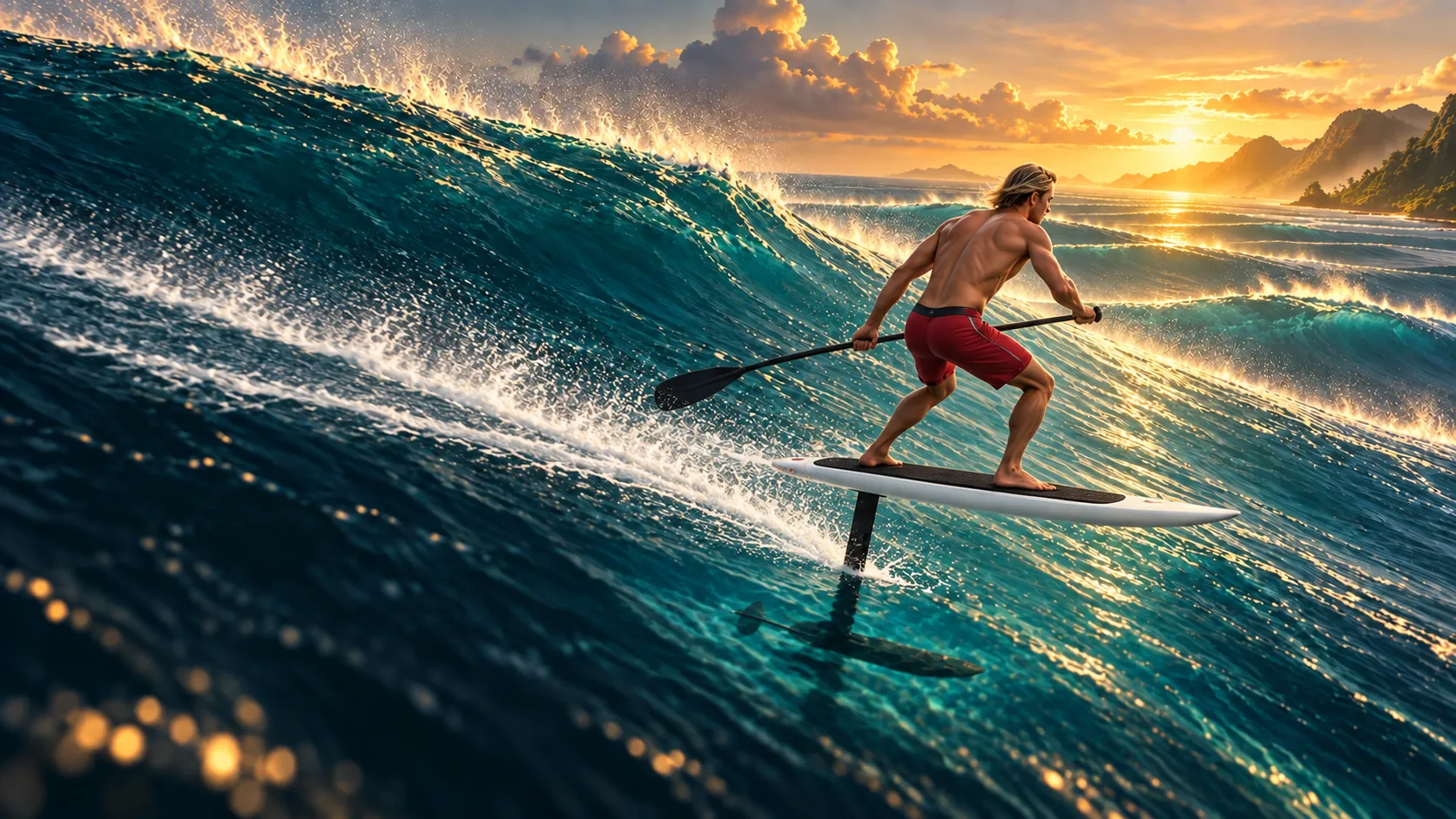
A foil SUP game for iPhone
Paddle onto the foil, pump between swells and carve down the face, from Oahu’s North Shore to the Columbia Gorge. Sharks, whales and a lifeguard on a jet ski all want a word. In development for iPhone.
DOWNWIND / ON YOUR TERMS
Voyager is a foil SUP game about moving water and a wing under your feet. Paddle onto the foil, bank across a face, then pump through the gap to the next swell. Change the ocean and you learn which lines carry speed. A seeded sea lets you run the same water again.
ON THE FOIL
Everything on this page labeled as gameplay is footage of the game in development. The hero image and the route art are concept art and say so.
STICK / SLIDER / WATER
Two controls run the ride: a stick that steers and leans, and a slider with Paddle at one end and Pump at the other. Start in Learning, which forgives the most, then try Medium or Advanced as your timing improves. Difficulty changes support and recovery. It never caps the wave size.
Slide to Paddle and stroke. Pull at the speed of the water and you hold your speed for free. Pull faster and you gain a little at a cost in energy. Pull too slowly and the stroke does nothing. Every pull buzzes the phone.
Slide to Pump, or press and hold the Pump end and let go. A longer hold sinks him deeper and pushes harder on release, up to a cap. Pumping spends your energy bar, so pick your moments.
Left and right bank the board. A foil cannot skid, so the lean you hold is the turn you get, and a hard bank asks more of the wing. Look where the next face is heading before you commit.
Push the stick up to lean on the front foot. A tap gives about two seconds of boost and a hold gives up to four, then a short bleed of speed. Keep holding on flat water and the foil sinks. Down a wave face the bleed is waived.
Hold Pump and push the stick all the way left. He snaps back over his heels, the blade dips into the water and throws spray, and he holds the turn.
Hold Pump and push right. His hands drop low, the paddle goes out and down, and the blade drags through the turn.
Rest your thumb on the Paddle side and flick the stick down. He swaps the paddle to his other side for reverse-paddle turns, then swaps it back.
Paddle plus stick up starts a toe-side carve that swings into a heel-side one. It is new in the latest build and still being tuned.
When a shark gets within about 15 feet, the Paddle end becomes STRIKE. He lets go with his back hand and chops the blade down at the shark.
REAL-WORLD HYDRODYNAMICS / UNDER THE SURFACE
Water flows past the foil, the wings generate lift, and drag spends the speed you worked for. Voyager calculates these relationships in real time, then adds adjustable assistance so you can learn to ride them.
 Explore the equations ↗
Directional wave components build the underlying surface. Each carries its own amplitude, direction, phase, and frequency. Wind swell and ground swell cross, overlap, and keep evolving beneath you.
A sets amplitude, k sets wavelength and direction, and ω sets the rhythm. The model uses the deep-water relationship ω² = gk: longer waves travel differently from short chop. Surface height and slope help the game identify useful wave energy; that riding cue is a gameplay estimate, not a measurement in joules.
The foil responds to speed relative to the moving water. Wing area and angle of attack affect lift too, so two moments at the same displayed speed can feel different. Drag grows with that same dynamic pressure.
Drag follows D = ½ ρv²SCD. Voyager combines profile, lift-induced, and near-surface spray terms. Its induced-drag coefficient uses CDi = CL² / (πeAR), linking lift demand to wing aspect ratio and efficiency.
Your foil meets water that is already moving. Changing pitch or trim changes its angle of attack, affecting lift and drag. Push beyond the model’s stall angle and lift falls away; bring a wing through the surface and support changes again.
The front wing and stabilizer contribute forces and pitch moments. Bank into a turn and some support points sideways. Demand more lift and induced drag rises. The model also responds to stall and wing immersion, with assistance adjusted by difficulty.
TRY THE SQUARE LAW
Hold wing area, water density, and coefficients fixed. Change only the water-relative speed.
Illustrative equation, not live game telemetry. During a ride, angles, coefficients, immersion, and assists also change.
Voyager combines spectral waves, simplified hydrodynamics, and gameplay assistance. The wave-energy cue estimates useful riding conditions from the surface; it is not an energy reading in joules. Read the field notes and equations ↗
A GAME YOU CAN LEARN SOMETHING FROM
You do not need the equations memorized. Change one setting, take another run, and notice what happens to your speed, height, and turning room.
Watch the moving face and the next swell’s direction. A high point alone does not guarantee useful push. Your heading, speed, and position on the face all matter.
Use a descending face to build speed, then turn toward another bump before the water softens. Pumping helps bridge the gap, at a cost to the rider’s energy.
As speed changes, so does lift. Learn how trim and wing immersion affect support, and why a hard bank can ask more of the foil.
Real water waves transport energy. Voyager models moving water and foil forces, with extra wave-face support and recovery assistance for playability. It can help you explore the relationships; on-water instruction and judgment still matter.
Follow the energy through the model ↗RACE ROUTES / REAL PLACES
Oahu’s North Shore, 2.8 miles downwind from Turtle Bay to the beach at Freddieland. Sharks, whales, sea turtles and a lifeguard jet ski share the course. Near the finish the bumps soften, and a timed swell will carry you in if you catch it.
Turtle Bay to Freddieland · Oahu
Six miles down the Columbia River from Rufus to Giles French Park, over real terrain data. Pass beneath the bridge and find the finish marker. Barges and patrol boats add something else to steer around while you link the wind bumps.
Rufus to Giles French · Columbia River Gorge
Launch beside Tunnel 4 west of the Hatchery and finish at the mouth of the White Salmon River, with the Hood River bridge farther east. Barges work the river, and a mecha shark patrols it.
The Hatch · Columbia River Gorge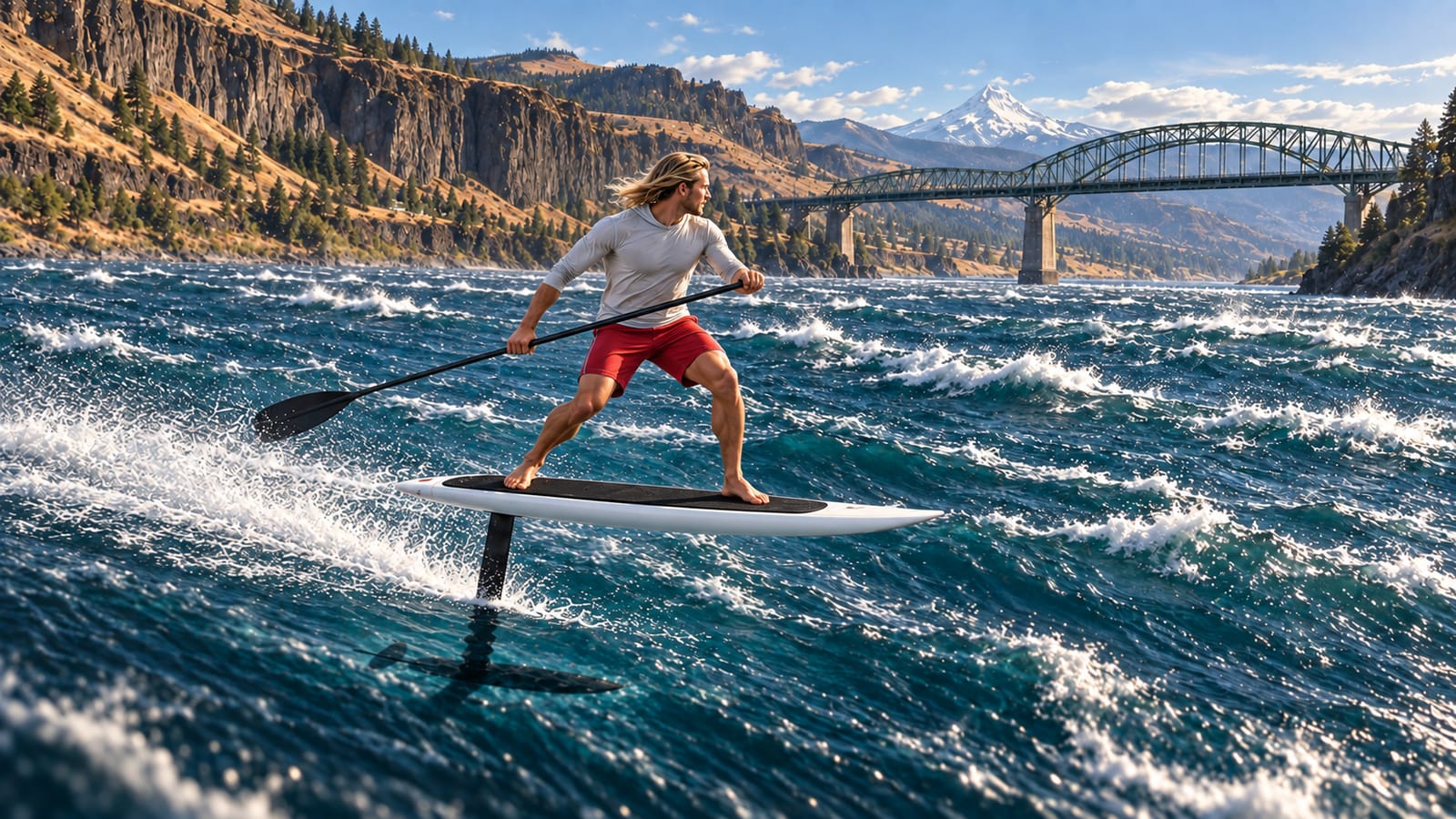
A fictional 3 km offshore run between weather-buoy gates, in a 20 ft storm sea. Ships cross the lane with wakes of their own, an oil platform sits in the murk, and the drops are steep.
Bering Run · offshore storm · fictional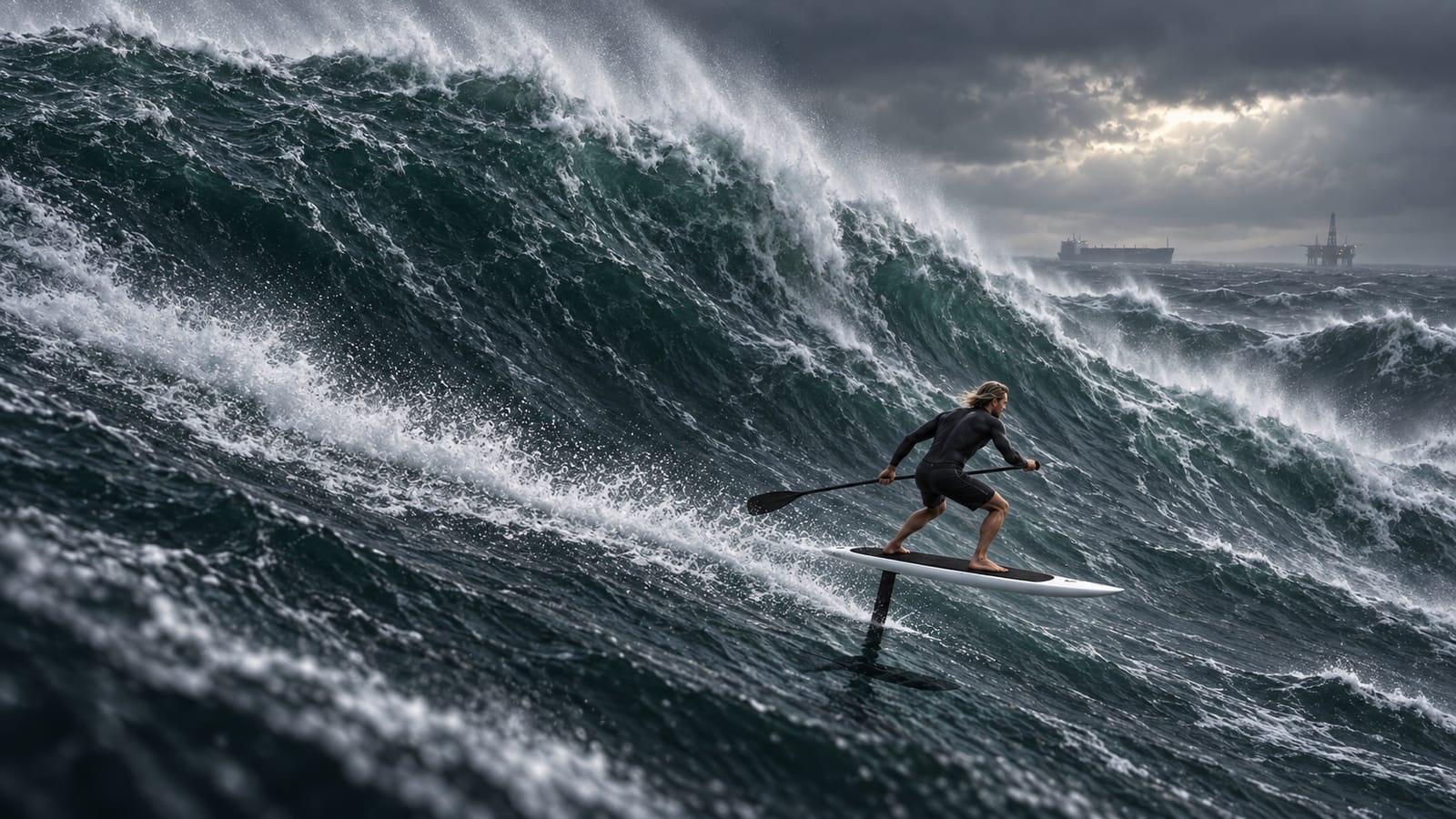 CONCEPT ART
Three more courses are in the game: Sunset, an open playground of long glassy shoulders where you go left or right and kick out at the buoys; Viento Express, a 1.5 km Gorge practice course; and a 400 m warm-up. Routes are based on real places. Coastlines and scenery are still being refined, and captures show development scenery.
WAVE LAB / TRY THE PHYSICS
Mix short wind swell with a longer ground swell, then move both toward a beach or reef shelf. Shallow water shortens the wavelength and bends the wave paths toward shore.
An educational wave model. Height here means crest to trough for each simple wave. The game uses a spectrum of many components; its wave-size setting describes a sea state. Coastal effects here are a teaching extension, not a simulation of either race course.
Across the beach shelf, both wave trains slow and shorten near shore. The wind swell turns from 55° to 17°, while both selected periods stay fixed.
TRAFFIC / WILDLIFE
Sharks circle before they commit. A whale breaches and lands where it lands. Sea turtles surface on your line, a lifeguard jet ski cuts across it, and barges and ships keep their course. Hit anything and you go over, with a fall chosen by the angle you were thrown. Each hazard has sliders for how often it shows up and how mean it is.


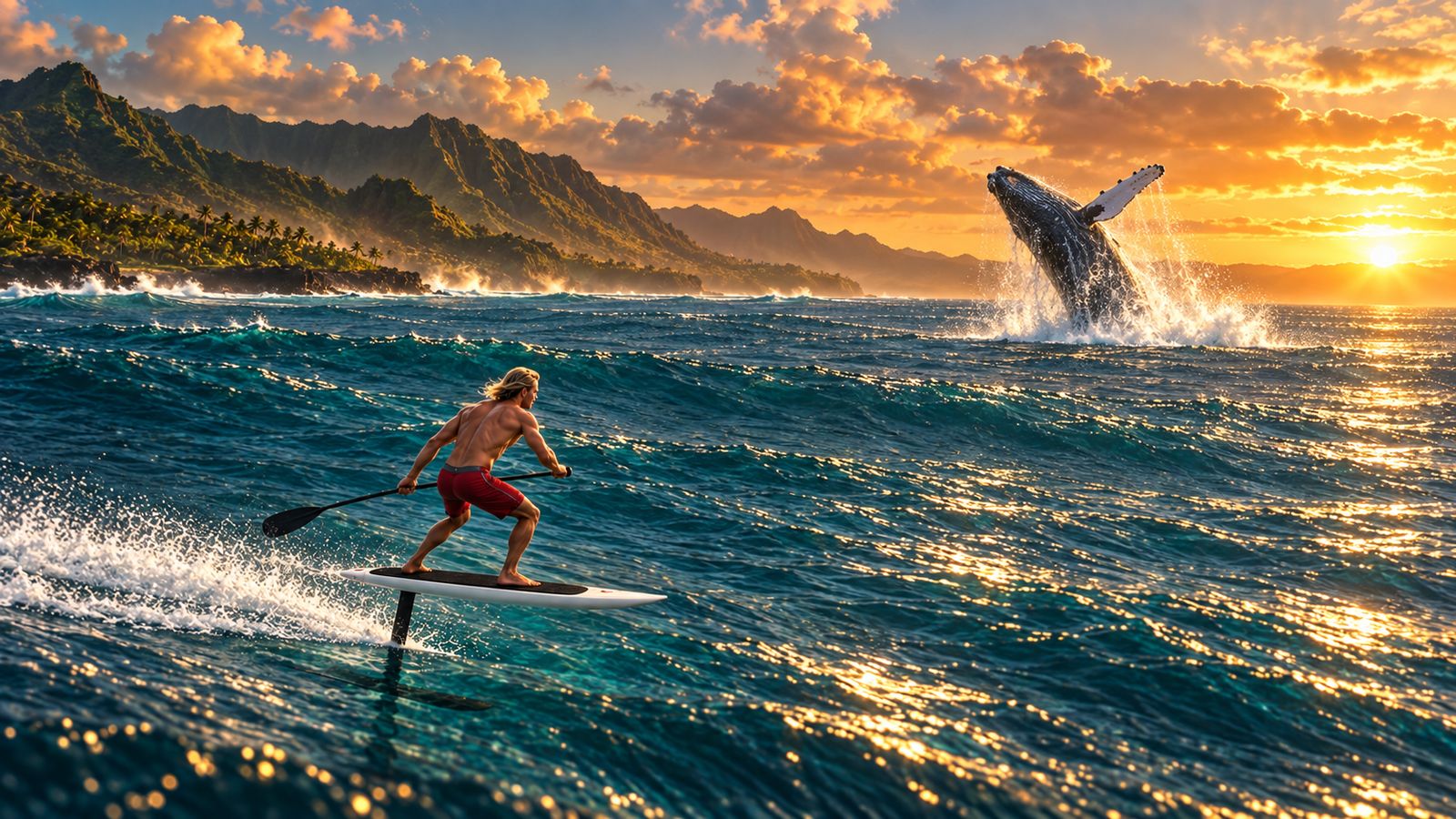 CONCEPT ART
Honu surface to breathe and leave a splash when they do. Hit one and the foil stops while you keep going. The turtle startles, dives away and is fine.
MEET THE LOCALS
The watercraft use the game’s rider models, including a driver and a second guard hanging onto a rescue sled. Apparently a perfectly good ocean still needs traffic.
Rotating source models show two red-uniform crew; crew differs from the game captures.


CHOOSE YOUR RIDER
Eight riders are in the chooser of the current development build. Only Core Lord Zack is past candidate stage; the other seven are being tuned. Nine more model files are still in the game but cannot be selected. The bios describe fictional characters, not the people who may have inspired them. Portraits are the game’s own rider-select faces; the turntables are the 3D models, not gameplay animation.
ON THE HORIZON / PLANNED FEATURES
Timed routes, wildlife and the storm run are already in the game. This is what we want to add next.
Timed runs and personal bests are in the game. Shared online rankings are planned, so friends can settle who actually rode the faster line.
Leaderboards · plannedDifferent stances, paddle carries and carve personalities for each rider. The same ocean, ridden a different way.
Distinct movement styles · plannedEarly lift or high speed? Long glide or tighter turns? A lineup of foils with different riding characteristics is on the roadmap.
Foil selection and tuning · plannedTurtle Bay and Rufus already wear satellite and aerial imagery on their shores. Next is a richer Turtle Bay backdrop, from the hotel and headlands to the beach finish at Freddieland, built for the view from the water.
Coastal scenery pass · plannedVOYAGER BETA / COMING SOON
Voyager is still in development for iPhone. A limited beta is planned once the ride, the courses and the performance are ready.
There is no public download or signup yet. Check back here for the next playable step.
Watch gameplayVOYAGER / iPHONE / IN DEVELOPMENT